
AI × OperationsFeatured Insight
AI Is Not the Transformation. The Workflow Is.
AI creates lasting value when it changes how the operation actually works, not when it is simply layered onto an existing workflow.
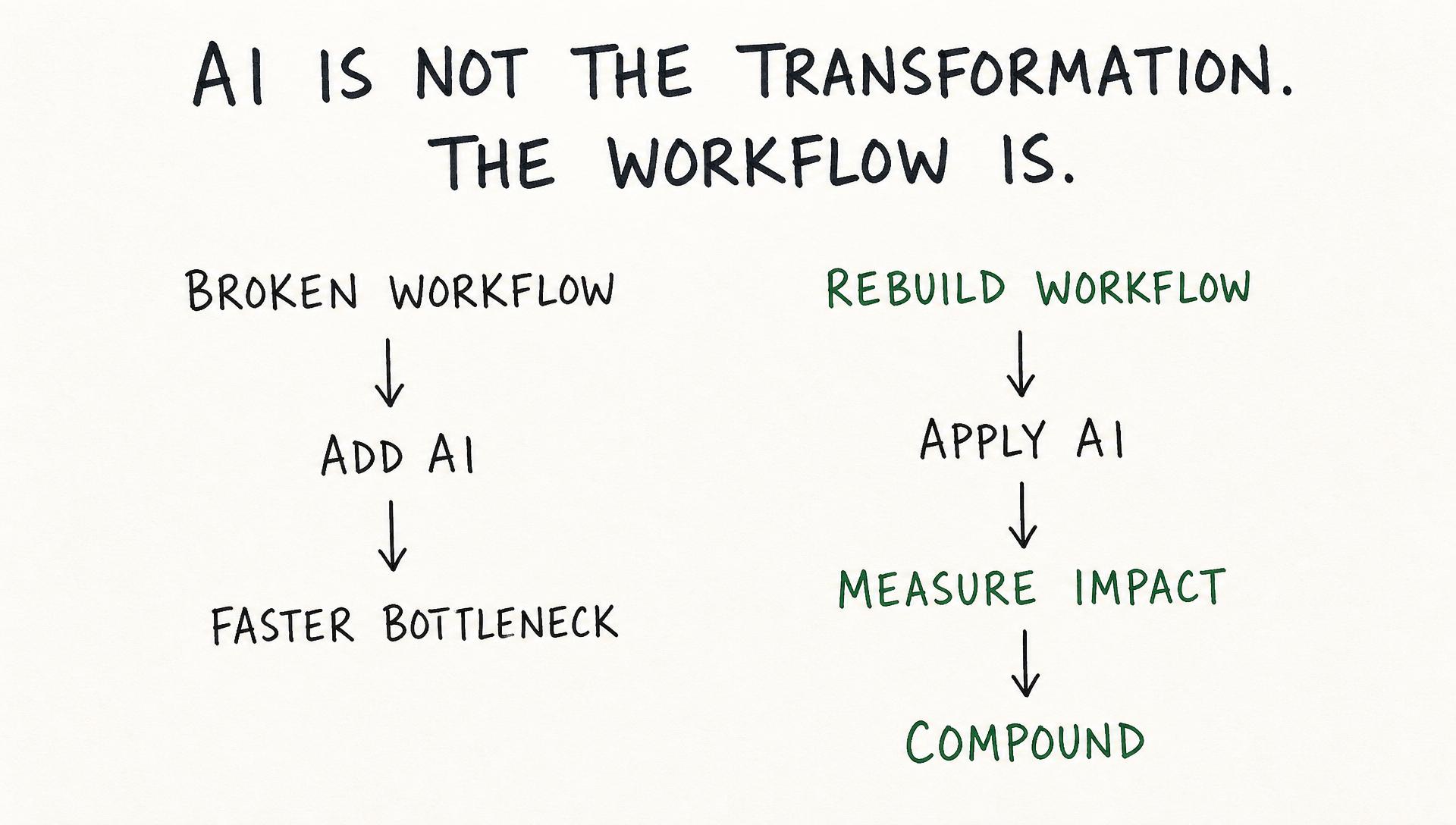
AI can make a task faster without making the operation better.
That distinction matters because much of the AI conversation still starts with what the technology can do. Can it generate the quote, improve pricing, manage an exception, or reduce manual work?
In many cases, yes.
But operations do not happen one task at a time.
A quote becomes an order. The order becomes a shipment. The shipment creates exceptions. Exceptions require decisions. The completed work still has to be invoiced, collected, and reconciled.
The work keeps moving even when the AI stops.
That is where the difference between automating a task and improving an operation starts to matter.
A quote can go from twenty minutes to two, but if the inputs are inconsistent, approvals still sit in email, operations has to re-enter information, or invoicing still depends on someone catching an exception, the business has improved one step without necessarily improving the workflow around it.
The bottleneck may simply have moved.
START WITH WHERE THE OPERATION IS LOSING VALUE
The first question should not be:
Where can we use AI?
It should be:
Where is the operation losing value today?
Where is work waiting? Where is margin disappearing? Where are people re-entering information, managing the same exceptions repeatedly, or compensating for gaps in the process with spreadsheets and operator judgment?
Those questions usually tell you more about the opportunity than starting with a tool.
And AI may absolutely be part of the answer. But sometimes the answer is cleaner data, a process change, a better handoff, a system integration, or simply removing work that should not exist in the first place.
That is why the operation has to come first.
BCG's recent research on AI in logistics points to a similar gap between AI investment and measurable financial impact, including the challenge of standalone solutions operating inside broader workflows.
I see that less as a technology problem and more as an operating one.
The tool can work exactly as intended while the operation around it barely changes.
THE SEQUENCE MATTERS
My bias is to start narrow, but go deeper than the task itself.
Find the value leak.
Understand where being slow, wrong, or inconsistent is actually costing the business money.
Rebuild the workflow.
Fix unnecessary steps, weak handoffs, and obvious data problems before automating them.
Apply technology where it changes the economics.
AI should improve a defined decision or outcome, not simply add another layer of automation.
Measure the result.
Cost, revenue, service, working capital, or another business outcome, not simply usage.
Then compound.
Extend what worked into the next connected part of the operation.
A faster quote matters more when it reduces rework downstream. A better exception decision matters more when it improves service and prevents billing errors. A cleaner billing process matters more when it gets cash into the business faster.
The compounding does not come from adding more AI.
It comes from improving connected parts of the operation so the value created in one place continues into the next.
A BETTER DEFINITION OF SUCCESS
We tend to evaluate technology by what it does.
Did it automate the task? Did it reduce manual effort? Did people use it?
Those questions still matter.
But I think AI requires one more:
Did the operation perform better because of it?
The companies that create durable advantage will not necessarily be the ones that deploy the most AI. They will be the ones that understand their operation well enough to know where technology belongs, what needs to change around it, and whether the business actually got better.
AI works when the operation underneath it works.
Further reading
BCG's 2026 research on AI in logistics examines the gap between AI investment and measurable financial impact, including the challenge of isolated solutions and connected workflows.
Read the BCG report ↗Working through a similar problem?